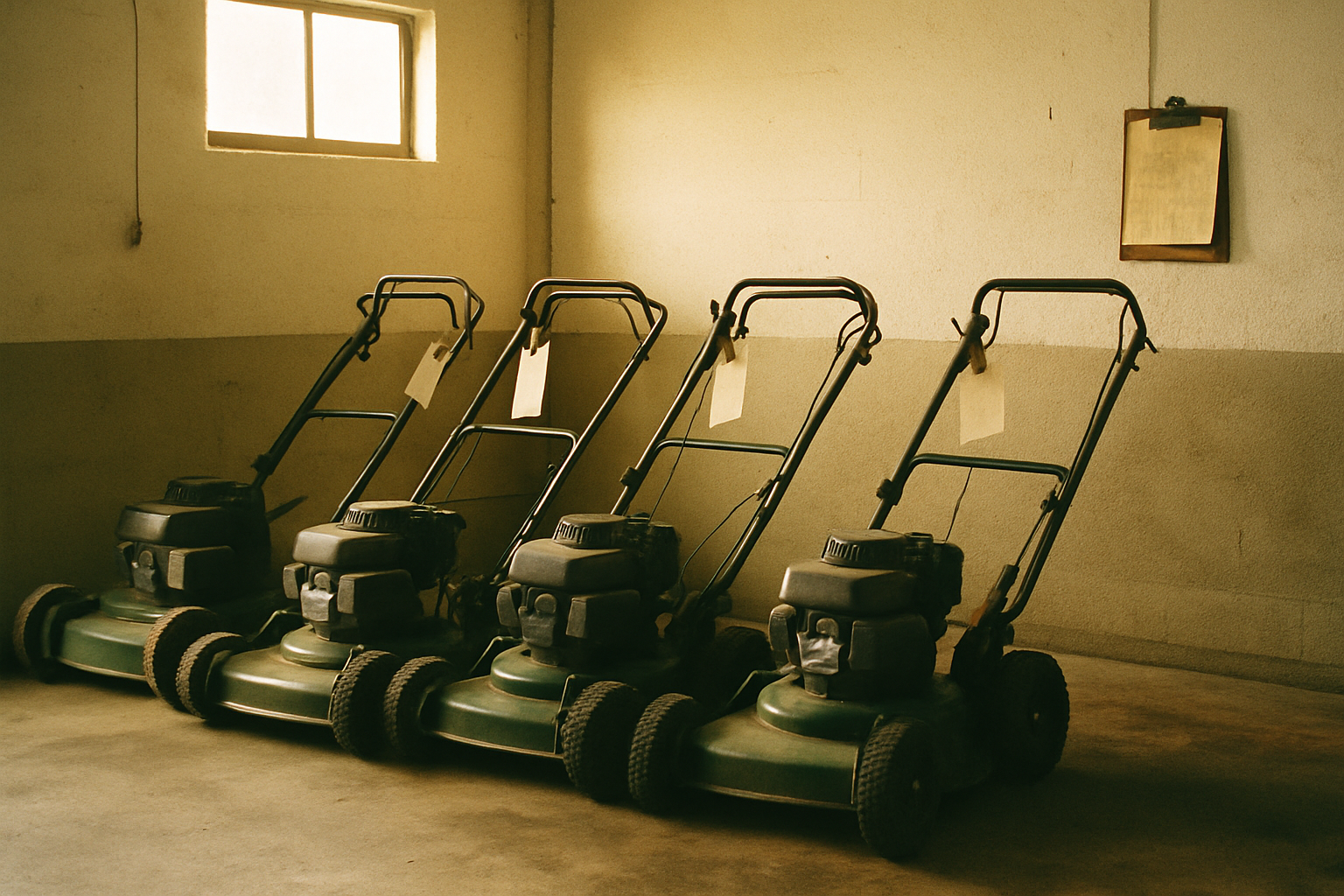
The shop we have seen make this mistake forty times
A five-crew shop, revenue around $900k. Margin stuck at 18% when the industry benchmark is 24–28%. The owner is baffled. The crews are efficient. Prices are fair. Routes are tight. Where is the money going?
In about 80% of the cases we see, a meaningful chunk is going into mower costs that are invisible because they have never been tracked as a line item. Blown deck bearings that should have been replaced before they damaged the spindle. A commercial mower used past its effective life that costs $180/week in downtime and repairs. Three $450/wheel replacements on an aging machine that should have been retired.
The mower as P&L line
Every piece of your mower fleet should have a one-row P&L in your head (or better, in a maintenance log in Servicio):
- Purchase price
- Expected productive life in hours (commercial zero-turn: ~2,000 hours; walk-behind: ~1,500 hours)
- Cost per productive hour = purchase ÷ life
- Maintenance cost trailing 12 months
- Downtime days trailing 12 months × crew day rate
- Revenue attributable to the mower (hours × productive rate)
- Net per productive hour — this is the number that matters
A 2021 commercial zero-turn that cost $11,200 has a cost-per-hour of $5.60 if it reaches 2,000 productive hours. At $95/hr of billable revenue produced on the deck, that is $89.40 of gross-margin-per-hour before labor. If the machine is now eating $2,400/year of maintenance and $3,200 of downtime-equivalent, the effective cost-per-hour is $8.40 and the gross rate is $86.60 — still fine. But if maintenance hits $6,000/year (seal leaks, spindle rework, hydro pump soft), cost-per-hour is $13.60 and you are hemorrhaging margin through a machine that "still runs."
The replacement rule
Replace the machine when maintenance + downtime exceeds 18% of the machine's original purchase price in a rolling 12-month window. For the $11,200 mower above: replace at $2,016/year of combined cost. Most owners wait until the number is 30–40%.
The psychological trap is that a working machine feels like value. A broken machine feels like cost. But a working machine with $4,600/year of maintenance is a much bigger P&L problem than a broken machine you buy your way out of on a weekend.
The cheapest mower you own is almost never the oldest one.
Tracking this in Servicio
Servicio's equipment module — shipped alongside the 2.10 industry-data-capture pass — lets you log maintenance events per equipment, cost per event, and downtime hours. Quarterly, the report rolls those up and flags any piece of equipment whose rolling-12-month cost exceeds the replacement threshold. It is a three-minute report that catches five-figure-a-year mistakes.