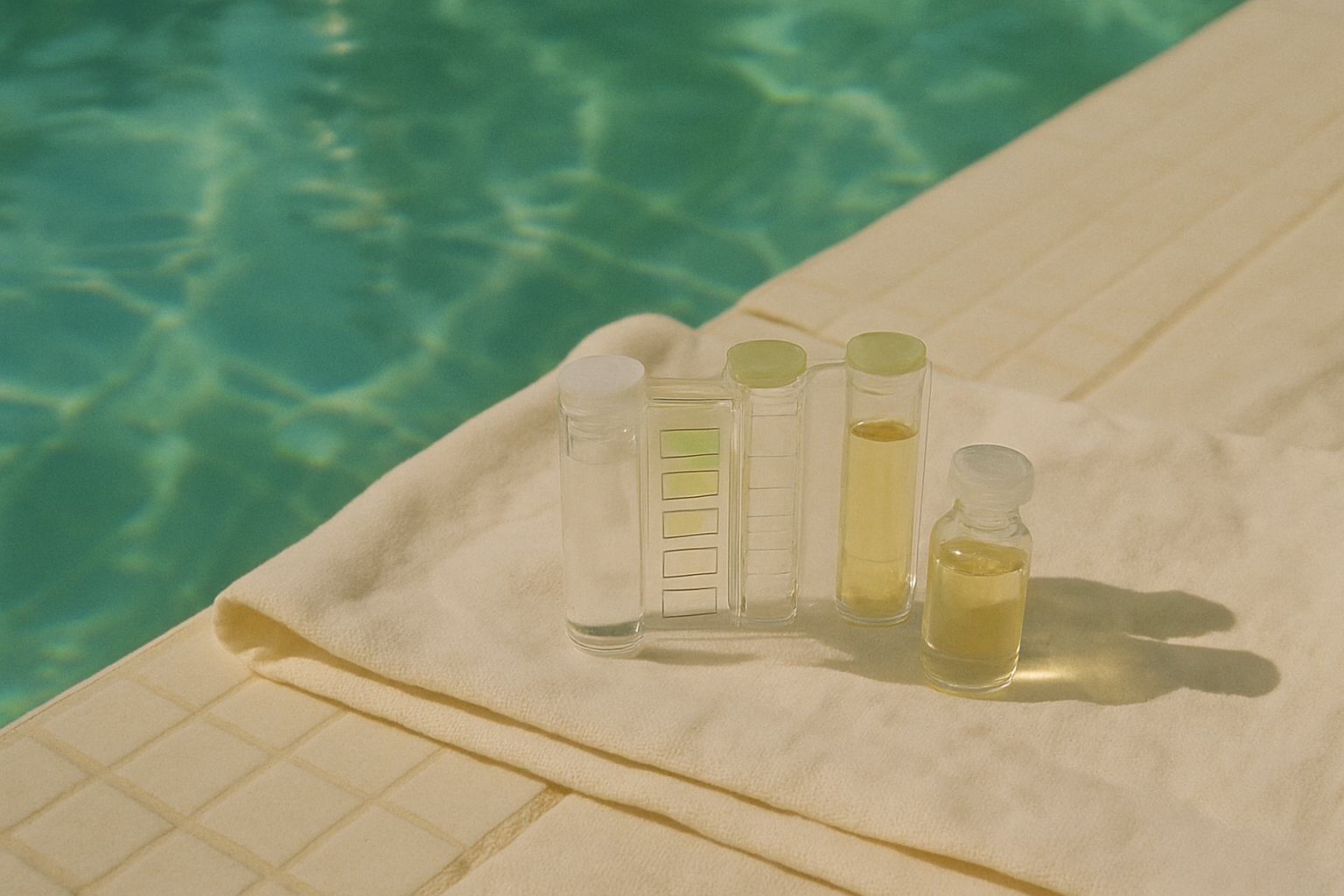
The six readings, ranked by how much they actually matter
A pool with perfect chlorine and terrible alkalinity will hurt a swimmer's eyes and look fine on camera. A pool with wrecked chlorine and perfect alkalinity will be cloudy green by Saturday morning. New techs tend to chase pH because it is the easiest reading; experienced techs chase free chlorine first, every visit, no exceptions.
- Free chlorine (FC): 2–4 ppm for chlorinated; 3–5 ppm for saltwater. Under 1 ppm, the pool is on its way to green regardless of what the owner says.
- pH: 7.4–7.6. Above 7.8, chlorine loses 50%+ of its killing power. Below 7.2, swimmer eyes burn and metal equipment pits.
- Total alkalinity (TA): 80–120 ppm. Think of TA as the buffer that keeps pH stable. Chasing pH without fixing TA is how pools ping-pong week over week.
- Cyanuric acid (CYA): 30–50 ppm outdoor, 0–20 indoor. This is chlorine sunscreen. Too low, sun eats your chlorine; too high, chlorine stops working even at correct ppm.
- Calcium hardness (CH): 200–400 ppm. Too low dissolves plaster; too high scales equipment. Low calcium is the silent killer of gunite pools.
- Temperature: Record it. Every chemistry reaction in the pool runs faster as temperature goes up. A 92°F pool needs ~30% more chlorine than a 76°F pool for the same sanitation.
LSI — the one number that replaces four readings
The Langelier Saturation Index combines pH, TA, CH, CYA, TDS, and temperature into a single "is this water aggressive or scaling?" number. Servicio calculates it automatically from the readings you enter. Keep it between −0.3 and +0.3 and you will not have equipment failures from water chemistry. Ever.
A negative LSI (under −0.3) means the water is corrosive. It will etch plaster, pit metal, and dissolve grout. A positive LSI (over +0.3) means the water is scaling. Calcium will build up on tile, heater cores, and salt cells. Most service complaints about "your chemicals ruined my heater" trace to LSI someone wasn't looking at.
Friday at 3pm: the pool is green, the party is Saturday
Every pool tech has been on this call. Here is the triage we teach new techs at Servicio-using shops:
- 1. Test the water immediately. Do not shock first. If FC is between 0.5 and 2 ppm, a light shock + brush + filter run may clear it by Saturday morning. If FC is under 0.5 and CYA is over 60, you are probably looking at a chlorine-lock situation that will not clear in 15 hours no matter what.
- 2. Brush the walls and floor. 80% of "green pool" calls are green algae that has not gotten free-floating yet. Brushing puts it into the water column where chlorine can kill it.
- 3. Shock to breakpoint. For green pools this is 10× your combined chlorine reading, minimum. In practice: one pound of calcium hypochlorite per 10,000 gallons for light green, two pounds per 10,000 gallons for moderate.
- 4. Run the filter continuously. Not on timer. Not "overnight". Continuously until the pool clears. Clean the filter every 8 hours.
- 5. Set expectations honestly. A light green pool clears in 24 hours. Moderate green is 48. Severe green (can't see the bottom at 3 feet) is 72+. If the party is tomorrow and the pool is severe green, it is not swimmable tomorrow. Tell the owner today. Servicio-using shops report zero lost customers from honest 24-hour lead-time calls, and every lost customer they have had from the Saturday morning surprise.
Logging that actually pays you back
Every reading you take should land in a system that remembers it. The value is not the individual reading; it is the trend. A pool whose CH has crept from 180 to 340 over 18 months is a pool that needs a partial drain before winter. A pool whose CYA is at 110 is a pool that needs a chlorine-lock conversation with the owner, with historical data to back it up.
Servicio ships with the industry-standard parameter grid built into the tech-side visit screen. Readings auto-check against the recommended ranges and flag out-of-bounds values before the tech submits. Every reading becomes part of the property's long-term chemistry log. Owner-facing reports draw from the same data so homeowners see the trend, not just today's snapshot.